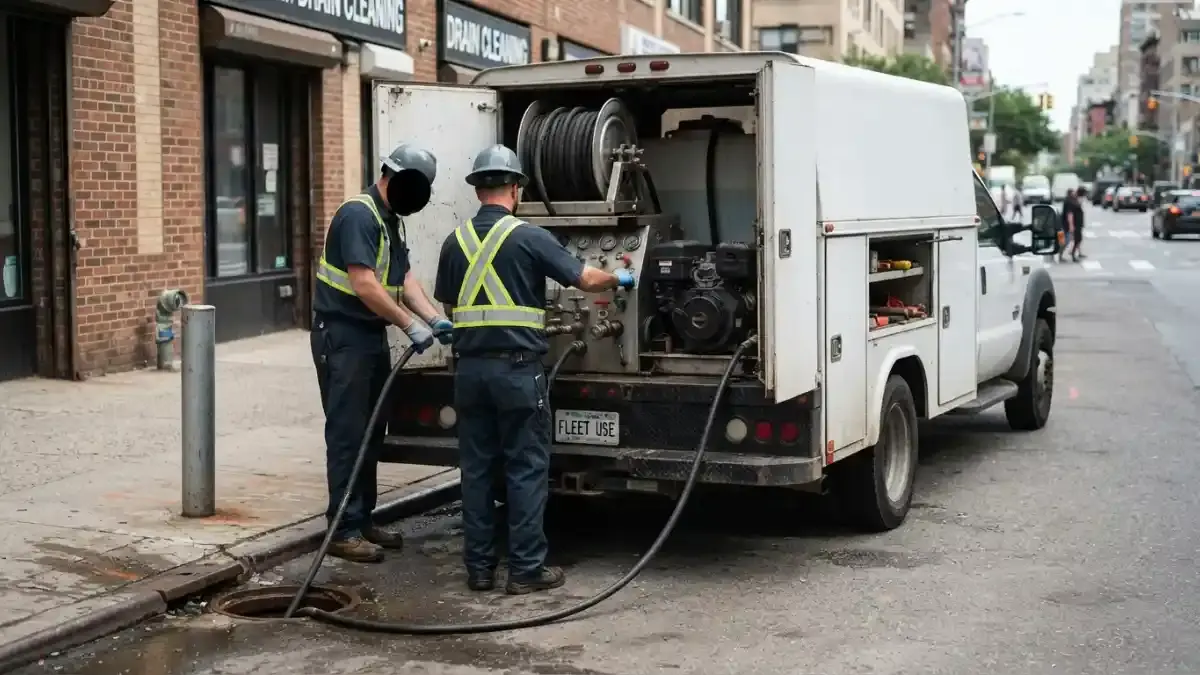
What hydro jetting does that a cable does not
A drain cable cuts a channel through a blockage. It leaves a coating of grease, scale and fine roots on the pipe wall, and that coating is what the next clog grows from. A jetting hose uses forward and backward-facing nozzles to blast water against the full circumference of the pipe, then the debris washes down to the main sewer.
That is why jetting is a common answer for lines that clog every few months. It also clears sand, silt and soap scum that a cutting head can miss.
When a clog is a jetting emergency
A fully blocked main line backs wastewater into the lowest fixture in the house, usually a floor drain, a basement shower or a ground-floor tub. That is a health and property problem, not a minor one.
While you wait for the plumber, do these things.
- 1Stop running water everywhere in the house, including washing machines and dishwashers.
- 2Keep people and pets away from any wastewater that has reached the floor.
- 3Locate your cleanout if you can. A cap near the foundation or in the yard tells us where to start.
- 4Do not pour chemical drain products into a backed-up line. They sit in the pipe and put the next worker at risk.
- 5Call and tell us how many fixtures are slow, gurgling or overflowing.
How a jetting visit runs
We do not start a jetter blindly. The process protects your pipes and tells us what we are dealing with.
- 1Camera look. A small camera shows what is in the line and whether the pipe is sound enough for pressure.
- 2Access. We use the cleanout, or pull a toilet, to feed the hose into the main.
- 3Jetting passes. The hose works down and back, loosening and flushing grease, roots and scale.
- 4Confirm. A second camera run shows the clean pipe, and we explain anything it reveals.
Jetting or cabling: which one fits
Both have a place. The choice depends on what the camera shows.
| Problem | Better fit | Reason |
|---|---|---|
| One slow bathroom sink | Hand cable | Local clog, short run |
| Grease buildup in a kitchen main | Hydro jetting | Water strips grease from the pipe wall |
| Roots at joints | Cutting head, then jetting | Cut first, then flush the cuttings |
| Cracked, offset or collapsed pipe | Neither. Repair needed | See sewer line repair |
When jetting is not the answer
Pressure is a tool, not a cure. If the camera finds a cracked clay pipe, a belly where water pools or a joint that has separated, jetting can make the damage worse or simply push debris around. We tell you that and recommend repair instead.
Fragile lines in older Chapel Hill neighborhoods deserve extra care. We check pipe condition first, then choose a nozzle and pressure that suit it, and we stop if the line responds poorly.
Why Chapel Hill lines clog the way they do
Mature trees are part of what makes Chapel Hill and Carrboro look the way they do, and their roots look for water at pipe joints. Our drain cleaning page covers the routine side of that problem, and jetting is the follow-up when roots keep returning.
Restaurants along Franklin Street and in Carrboro's downtown add a different cause, grease. Grease gets into sewer laterals and cools, and jetting is the usual fix. Our commercial plumbing page covers grease trap upkeep, which prevents the buildup in the first place.
What a hydro jetting job depends on
We quote a clear price before work starts, and the main drivers are listed here.
Sewage backups are often excluded from standard homeowner policies unless you added an endorsement. Check your policy before you need to.
Why cleanouts and pipe condition set the limits
The International Plumbing Code (IPC), which North Carolina's plumbing code is built on, expects cleanout access in drain lines, and that access is what makes jetting practical. Industry groups such as NASSCO publish defect coding for pipe condition, and we use the same plain categories when we describe cracks, offsets and roots on camera.
A line with a clear cleanout and sound pipe is a good candidate. A line without either gets a closer look first.
Need the line cleaned properly?
Call our 24/7 line and we will plan the camera look and the jetting pass together.
Common questions
It depends on the pipe. We run a camera first and avoid jetting fragile or broken lines. If the pipe is sound, jetting is gentler on the walls than hard cutting.
Our line is answered 24/7. For a full sewer backup we send a plumber as soon as one is available, and we offer same-day appointments when available for repeat clogs.
A snake makes a hole through a clog. A jetter washes the entire pipe wall. For repeat blockages, jetting usually lasts longer.
It clears fine roots well. Thick roots are cut first, then flushed. If roots keep coming back, the pipe likely has a joint or crack that needs repair.
Yes. See our Carrboro page for neighborhoods and ZIP codes.