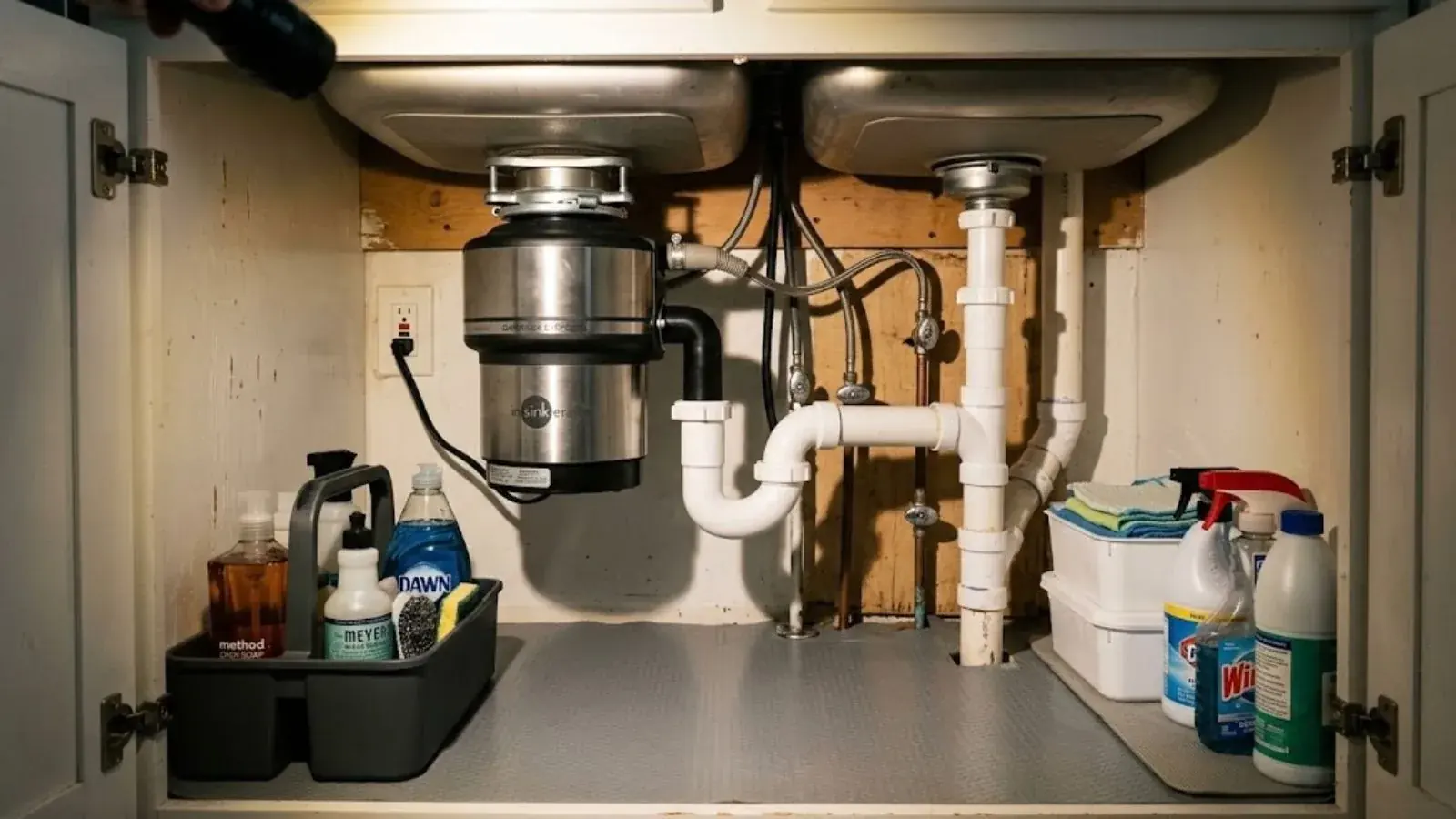
How the pieces connect
Water leaves the sink through a basket strainer, which is bolted into a mounting assembly that clamps to the sink. The disposal hangs from that assembly. Its outlet on the side connects to a short pipe leading to the trap and the wall drain. The dishwasher drain hose connects to a nipple on the disposal, so dishwasher water passes through the disposal chamber on its way out.
Understanding the path explains the problems. A clog past the disposal backs water into the sink. A blocked dishwasher nipple backs water into the dishwasher. A loose mounting ring leaks at the top.
Before you start
Collect these items, and confirm the electrical details.
- ✓The disposal, mounting hardware and the sink flange kit.
- ✓A discharge tube and the right fittings for your trap.
- ✓A dishwasher connection kit if the dishwasher is new.
- ✓A power cord or a plan to hard-wire, and a switched outlet under the sink.
- ✓Plumber's putty, a screwdriver, pliers and a hex wrench.
- ✓A clear cabinet. Empty it and put a bucket underneath.
Order of work
Doing these in order prevents rework.
- 1Remove the old unit. Disconnect power first. Then take off the discharge and dishwasher hose and loosen the mounting ring.
- 2Seat the flange. Press a rope of plumber's putty under the flange lip and tighten the mounting assembly.
- 3Hang the disposal. Lift it onto the ring and lock it in place.
- 4Open the dishwasher knockout. A plug in the dishwasher nipple must be knocked out on a new unit, or the dishwasher will not drain. Remove it from the inside.
- 5Connect the drain and hose. Attach the discharge to the trap and the dishwasher hose with a clamp.
- 6Wire and test. Connect power, then run water and check every joint for leaks.
The knockout plug that traps beginners
New disposals ship with a plug in the dishwasher inlet so a unit without a dishwasher does not leak. If you forget to knock it out, the dishwasher cannot drain and sits full of dirty water. Make it the last thing you check before you close the cabinet.
Common problems after a new install
Most call-backs come from a small set of mistakes.
| Problem | Likely cause | Fix |
|---|---|---|
| Leak at the top | Putty missing or flange not tight | Reseat the flange |
| Leak at the side | Loose discharge or dishwasher clamp | Tighten or replace the gasket |
| Dishwasher will not drain | Knockout plug still in place | Remove the plug |
| Disposal hums only | Jam or no free movement | Use the hex socket on the bottom to free it |
| Slow sink | Clog past the disposal | See drain cleaning |
What Chapel Hill and Carrboro kitchens bring
OWASA's water quality report advises rubber parts that resist chloramine, which includes the gaskets and hose connections in a disposal and dishwasher. Replace old rubber gaskets and clamps when you install a new unit.
Rental homes near the UNC campus and Franklin Street see heavy kitchen use. Older homes near the historic districts can have older drain lines in the wall that are narrow or partly blocked. If a new disposal keeps backing up, a camera look, covered on our sewer inspection page, shows whether the problem is farther down.
Electrical and permit notes
A disposal needs power from a switched outlet or a hard-wired connection. If you are adding a new circuit or a switch, a licensed electrician may be required and a permit may apply. The Town of Chapel Hill lists plumbing work under its Trade Work permit. Carrboro addresses use the town's inspections office.
If you are replacing a disposal in the same location with the same connections, the job is normally a simple swap. If you are moving the sink or the drain, see plumbing installation.
Choosing a disposal
Disposals come in continuous-feed and batch-feed styles. A continuous-feed unit runs as long as the switch is on and is the most common. A batch-feed unit runs only when a stopper is in place, which some people prefer for safety around children.
Horsepower affects how well a unit handles tough scraps and how it sounds. A larger motor usually runs smoother and more quietly, and it also costs more. Sound insulation, stainless steel grinding parts and a longer warranty are features worth comparing. A cheap unit in a household that cooks daily tends to jam and wear out.
Check that the unit fits under your sink. Cabinets with a deep basin, a dishwasher on one side and a trap that sits low can leave little room. We measure before we order, because a disposal that does not fit is an expensive lesson.
Code references for the hookup
The International Plumbing Code (IPC), which the North Carolina Plumbing Code follows, expects a dishwasher drain to rise in a high loop or pass through an air gap. Disposal wiring falls under the National Electrical Code (NEC), and a switched outlet or a hard-wired connection should be installed to that standard.
Common questions
Yes. Leave the knockout plug in place and cap the dishwasher inlet.
A swap of one disposal for another usually takes an hour or two. A new install with wiring takes longer.
Horsepower affects grinding power and noise. A household that cooks often benefits from more power.
Our line is answered 24/7. Most installs are scheduled, and we offer same-day appointments when available.
Yes. See our Carrboro page and all of our service areas.