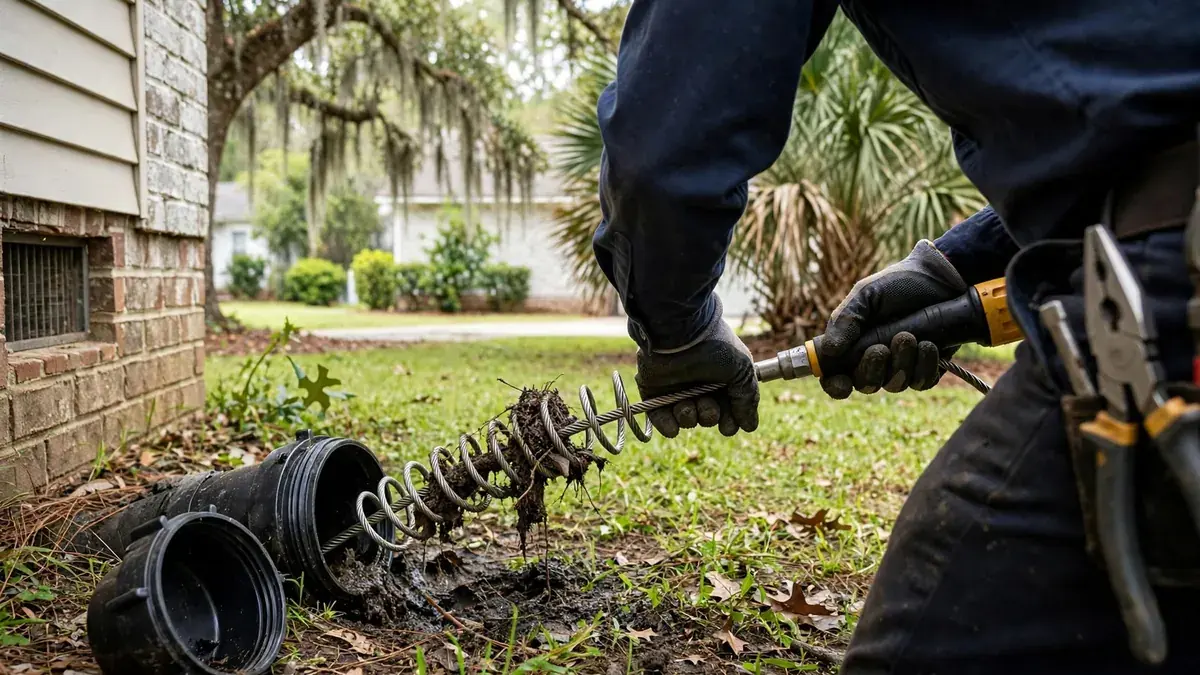
Main line clogs versus a clogged sink
A clog in one sink stays in that sink. A clog in the main line affects the whole house. Wastewater from every fixture flows to the main, so when it backs up, the lowest drain shows it first. A basement floor drain that gurgles when the washer drains is a classic sign.
Sewer line cleaning is the work of removing that blockage from the cleanout or the pipe below the house to the connection at the street or septic tank. The method depends on what the blockage is made of.
If sewage is coming up right now
Wastewater backing into a home needs a quick response. The steps below limit the mess until the plumber arrives.
- 1Stop all water use in the house until the line is clear.
- 2Keep everyone away from the affected room and do not walk through wastewater barefoot.
- 3Move belongings off the floor and open windows for ventilation if it is safe.
- 4Locate the cleanout. It is a capped pipe, usually near the house or at the edge of the property.
- 5Call us. Mention how many fixtures are affected and whether it happened after heavy rain.
What causes main line clogs
The common causes are tree roots, grease, flushed wipes and paper towels, and collapsed or sagging pipe. Rain can make it worse in older systems, because groundwater can enter through cracks and joints.
Chapel Hill and Carrboro both have mature tree cover, so roots are a usual suspect. In newer communities such as Meadowmont and Southern Village, the age of a line is only a starting point, so we look with a camera before we recommend a repair.
Methods we use on a main line
We pick the least aggressive tool that will do the job.
| Cause | Tool | Notes |
|---|---|---|
| Soft clog, paper or wipes | Cable machine | Opens the line quickly |
| Roots | Cutting head, then rinse | May need follow-up jetting |
| Grease | Jetter | Strips the pipe wall |
| Collapsed or offset pipe | Camera, then repair | See sewer line repair |
Do not flush wipes, even the ones that say flushable
Wipes that say flushable often do not break down the way paper does. They collect on roots and rough pipe walls and form a mat that catches everything else. Put them in the trash. Kitchen grease belongs in a can, not down the drain.
Rain, creeks and the sewer system
Heavy rain can overload sewer systems and flood low-lying areas. Bolin Creek and Morgan Creek run through the area, and the July 2025 flooding left some residents displaced. If sewage backs up during or after a storm, tell the dispatcher, because the cause may be different from a normal clog.
OWASA operates the public sewer. If a backup affects multiple homes on your street, a problem in the public main is possible, and OWASA should be called.
What sewer line cleaning costs depend on
We quote a clear price before work starts. The main drivers are below.
Cleaning does not repair a damaged pipe. If the camera shows damage, we explain the options.
Cleanouts and the plumbing code
The North Carolina Plumbing Code, built on the International Plumbing Code (IPC), expects cleanouts on building drains so they can be serviced. If yours was buried by landscaping or never installed, tell us. A properly placed cleanout makes every future cleaning faster and lets us avoid pulling a toilet.
OWASA, not the homeowner, is responsible for the public main, and we help you find the line between the two.
Whole house backing up?
Call now. We will tell you what to do and send a plumber.
Common questions
Look for a capped pipe, often white plastic or black cast iron, near the foundation, in a crawlspace or near the property line. If you cannot find it, we can.
Yes. Our 24/7 line takes calls any time, and we offer same-day appointments when available for non-emergency cleaning.
There is no fixed schedule. Lines with roots or grease may need cleaning every year or two. A camera inspection tells us whether the line needs regular cleaning or repair.
Groundwater can enter older pipes through cracks and joints, filling the line faster than it drains. A camera shows whether that is the cause.
Yes. See our Carrboro page.