Find the source before choosing a fix
Water that appears after rain points to groundwater or surface runoff. Water that appears on a dry day points to a pipe. Condensation on cold pipes and humid summer air can look like leaks when they are not. We look at the pattern before we recommend anything.
Plumbing can do part of the job, like drains, sump pumps and discharge. Other parts are outside plumbing, like grading, gutters and foundation sealing. We tell you where our work ends and where another trade starts.
Where water comes from and what helps
A short guide to the usual sources.
| Source | Clue | Typical answer |
|---|---|---|
| Roof and gutters | Water near downspouts after rain | Extend downspouts, clean gutters |
| Surface grade | Soil slopes toward the house | Regrade, add swales |
| Groundwater | Water rises in the floor or pit | Drain and sump pump |
| Leaking pipe | Water on a dry day, meter moves | Leak detection |
| Sewer backup | Dirty water at floor drains | Line cleaning |
Crawlspaces in Chapel Hill homes
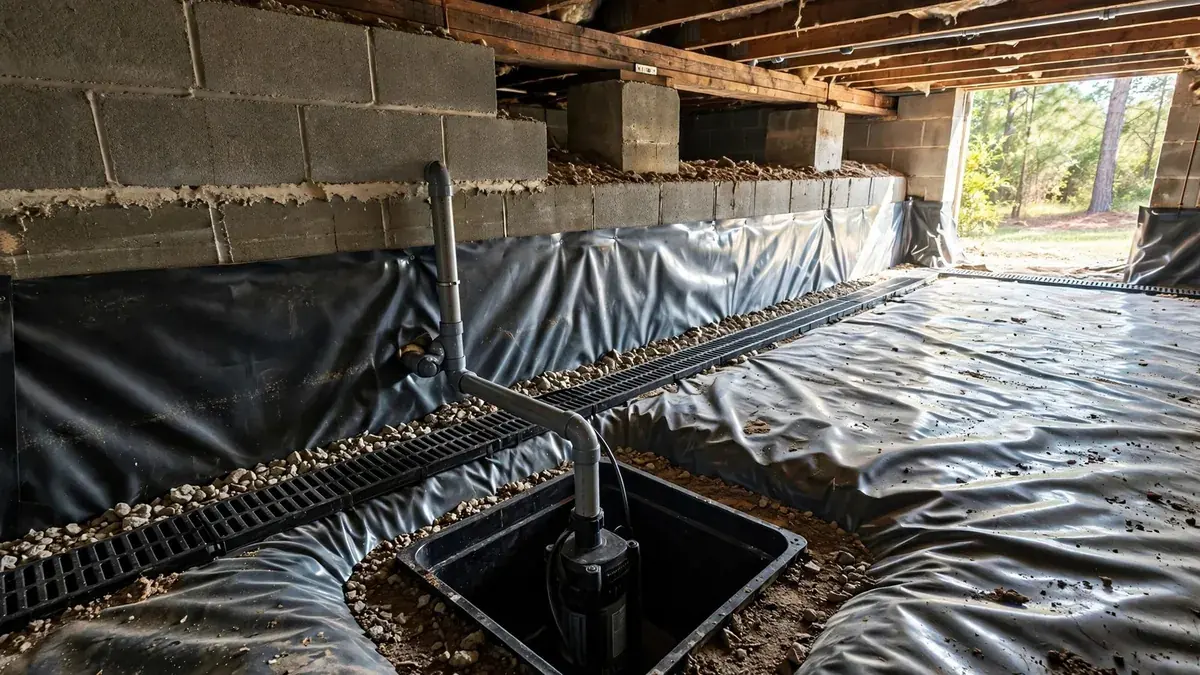
Many Chapel Hill and Carrboro homes sit on crawlspaces, and a wet crawlspace can damage insulation, support timbers and ductwork. Standing water, a musty smell or sagging insulation tells you something is wrong. A vapor barrier and drainage can help, and a sump pump can handle water that collects.
A crawlspace that is wet only after long rain is different from one that is wet all year. We explain which pattern you have and what it points to.
Creeks, storms and the 2025 flooding
Chapel Hill and Carrboro sit on or near creeks such as Bolin Creek, Morgan Creek and Booker Creek. Flash flooding in early July 2025 displaced residents of several Chapel Hill apartment and condo communities, according to Carolina Public Press, and Tropical Storm Chantal flooded about 45 of roughly 55 homes at Weatherhill Pointe in Carrboro, according to Spectrum News.
That kind of flooding is a drainage and floodplain problem, not a plumbing fix. If you live in a flood-prone area, ask the Town and your insurer about flood maps and flood coverage. Standard homeowners policies usually do not cover flood.
What plumbing can and cannot do
Being honest about limits is part of the job.
What we do
We install and repair sump pumps, discharge lines, interior drains that tie into a pit, backwater valves on sewer lines and the plumbing that moves water out of the house.
What others do
Exterior grading, foundation crack injection, gutter systems and structural waterproofing are separate trades. We recommend them when your problem calls for it and we do not claim to waterproof what we cannot.
Dehumidifiers, vapor barriers and the limits of drying
A dehumidifier can lower the humidity in a damp basement, and a heavy plastic vapor barrier over crawlspace soil can slow moisture rising from the ground. Both help with dampness. Neither stops liquid water from coming in during a storm, and neither replaces a pump when the pit fills.
If a space smells musty, check for visible mold and see whether the dampness follows the weather. Mold on more than a small patch of surface is a job for a remediation company, and we say so honestly when we see it.
What drives the cost
We quote a clear price before work starts.
Planned waterproofing is not covered by insurance. Sudden water damage may be, depending on the cause.
What FEMA says about flood and water coverage
FEMA's National Flood Insurance Program (NFIP) is the federal flood policy, and standard homeowners policies typically do not include flood. If your home is in a low area near a creek, ask the Town and an insurance agent whether it sits in a mapped flood zone and what coverage applies.
Drainage work helps with ordinary wet weather. It does not make a house flood proof.
Water getting in?
Call and tell us when it appears. We will plan the visit.
Common questions
We handle the plumbing side, including sump pumps, drains and discharge. Structural waterproofing is a separate trade and we say so when it is what you need.
Groundwater or surface runoff is the usual cause. A pump and drainage help. We find the source first.
Our line is open 24/7. For active flooding, call and we will tell you what to do. We offer same-day appointments when available.
Usually not for groundwater or flood. Sudden pipe failures may be covered. Ask your agent.
Yes. See our Carrboro page.