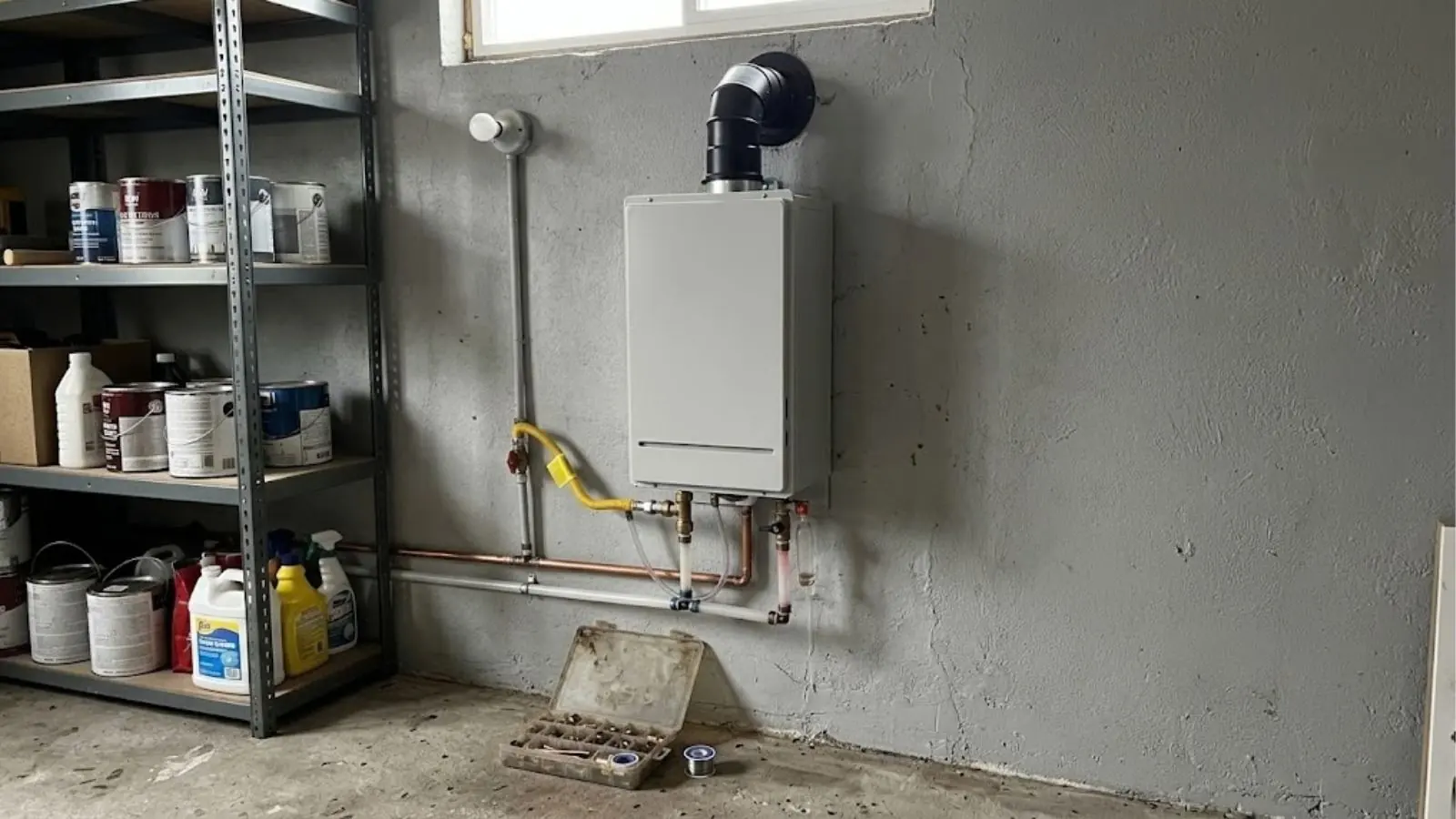
Start with the flow you need
Tankless units are rated by the gallons per minute they can heat to a given temperature rise. Temperature rise is the difference between the cold water coming in and the hot water you want. In a mild season the rise is smaller and the unit delivers more. In winter, the incoming water is colder and the same unit delivers less.
Add up the fixtures you might run at once. A shower, a bathroom faucet and a dishwasher together draw several gallons per minute. A household with two bathrooms in use at the same time needs more capacity than one with a single bath.
Fixtures and rough flow
Check the flow rate on your own fixtures. These ranges show how it adds up.
| Fixture | Typical flow | Note |
|---|---|---|
| Showerhead | About 1.5 to 2.5 gallons per minute | Check the rating on the head |
| Bathroom faucet | About 0.5 to 1.5 | Varies by model |
| Kitchen faucet | About 1.5 to 2.2 | Check the aerator |
| Dishwasher | About 1 to 2 | Draws during fill |
| Washing machine | About 1.5 to 3 | Hot setting only |
We read the labels in your home instead of guessing.
Gas, electric and venting
Gas tankless units need more gas at once than a tank. An older half-inch gas line may not carry enough, and the meter may need to be checked. They also need correct venting, usually stainless steel or plastic depending on the efficiency, run to the outside.
Electric tankless units need heavy electrical service. A whole-house electric unit can draw more current than a panel has available. We check the panel and tell you if an upgrade is needed before you spend on the unit.
How we check a house
Our site visit follows a set order.
- 1Existing heater. Location, fuel, vent path and age.
- 2Gas or electric supply. Meter, line size or panel capacity.
- 3Vent route. Where it can exit and what clearance is required.
- 4Water quality and pressure. Incoming pressure and any sediment problems.
- 5Fixture count. Flow at peak demand.
- 6Permit. Chapel Hill lists water heaters under its Trade Work permit and Carrboro uses its own office. We confirm for your address.
Things local to Chapel Hill and Carrboro
OWASA's water quality report does not list a hardness figure, so we do not guess how fast a unit will scale. A flush after the first year shows how your water behaves. OWASA also advises chloramine-resistant rubber parts for connectors and valves.
Many Meadowmont and Southern Village homes have gas service and mechanical closets that make venting a challenge, while older homes near the historic districts may have a crawlspace and a gas line sized for a tank. See water heater replacement and water heater installation for how we plan a swap.
When a tank is the better choice
If your gas line and venting would need major work, a modern tank may give you what you need for less. If you have a small household with predictable use, a tank is often enough. We will tell you honestly.
Questions to ask any installer
Ask how the unit was sized, whether the gas line was measured, where it will vent and who pulls the permit. Ask what the maintenance schedule is, what the flush involves and whether the manufacturer requires it for warranty. Ask for the model's flow rate at your local winter temperature rise, not a marketing number.
If an installer cannot answer these, keep looking.
Maintenance and what to expect over the years
A tankless heater is not maintenance free. The heat exchanger can collect mineral scale, and the inlet screen can clog with debris. The manufacturer publishes a flushing schedule, and following it is usually a warranty requirement. A flush circulates a descaling solution through the exchanger and rinses it out.
Venting needs a periodic look, especially for condensing models that produce acidic condensate. The condensate drain has to run to a proper drain or a neutralizer. A blocked condensate line can shut a unit down.
Expect to deal with error codes occasionally. Most are simple, such as a blocked vent or a flow sensor that needs cleaning. A plumber who knows the brand can read the code and tell you what it means. Our tankless water heater page covers repair and flushing.
Putting the numbers together
Write down your busiest hour in a typical week, with every fixture that runs at the same time. Add up the flow, check the temperature rise for the coldest water you expect and compare that figure with the unit's rated capacity. If the result is close, ask for the next size up. Bring the numbers to your installer, and ask them to show the math instead of quoting a unit by bedroom count.
Standards and instructions that govern the install
Every tankless install should follow the manufacturer's installation instructions, which set gas line size, vent type and clearances. Electric units must be wired under the National Electrical Code (NEC), and venting and gas piping follow the fuel gas code adopted in North Carolina.
Common questions
It depends on fuel prices, your usage and the installation cost. Standby loss is lower, but the upfront cost is higher. We do not promise a number.
Manufacturers state expected lifespans. Maintenance such as flushing matters.
Most gas tankless units need electricity for the controls, so they stop without power. Ask about a backup.
Our 24/7 line takes calls any time. Installs are usually scheduled, and we offer same-day appointments when available.
Yes. See our Carrboro page and all of our service areas.